
This might seem like something you’d just know — but plenty of people genuinely aren’t sure whether their dryer runs on gas or electricity, especially in a rented home. It matters more than it sounds: they use different hookups and require different repair approaches, so knowing how to tell if dryer is gas or electric is a vital first step for any homeowner.
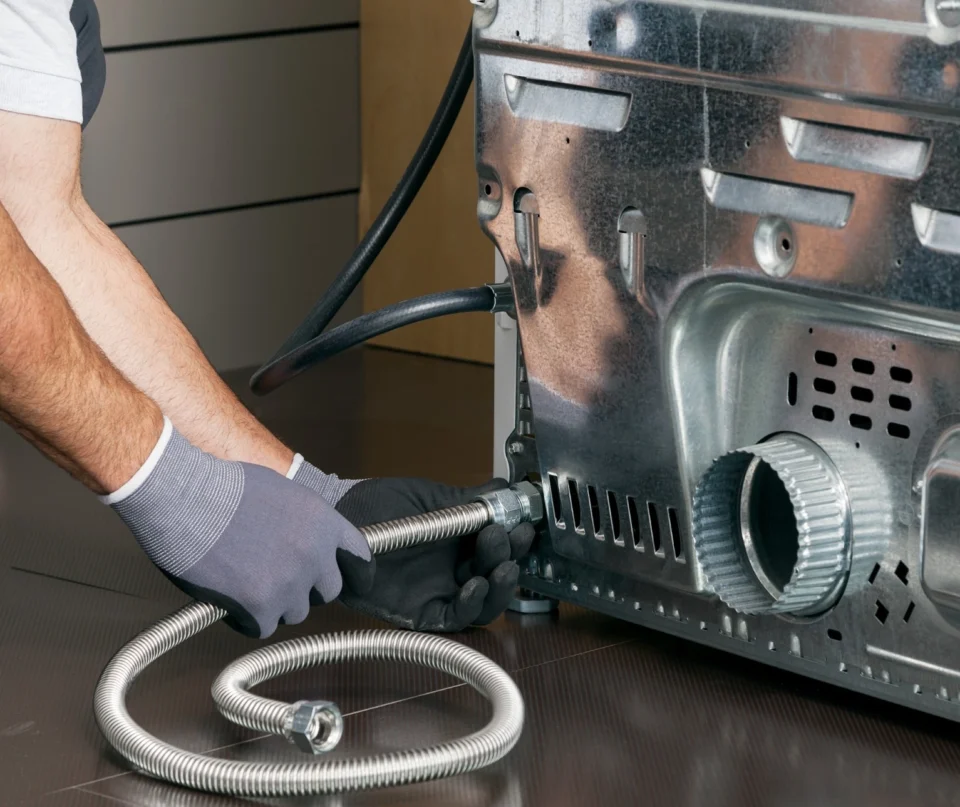
The fastest way to tell if your dryer is gas or electric is to look at the power cord and the connection behind the dryer. An electric dryer uses a large 240-volt plug with 3–4 prongs and connects only to an electrical outlet. A gas dryer uses a standard 120-volt plug (just like a lamp) AND has a separate gas supply line — a metal or flexible pipe connected to the wall behind the unit.
Method 1 — Check the Power Cord and Plug (Fastest Method)
Pull the dryer slightly away from the wall and look at the plug and outlet.
| What You See | What It Means |
| Large plug with 3 or 4 thick prongs going into a large 240V outlet | Electric dryer |
| Standard household plug (2–3 prongs, same as a lamp or TV) | Gas dryer |
A gas dryer only needs 120 volts for the motor, controls, and igniter — it generates heat from burning gas, not electricity. An electric dryer needs 240 volts to power the electric heating element.
If the outlet is a large, round 240V socket (looks different from regular outlets), it’s definitely electric.
Method 2 — Look for a Gas Line Behind the Dryer
Pull the dryer forward and look behind it.
- See a metal pipe or flexible corrugated hose connecting the dryer to the wall? That’s a gas supply line. Your dryer is gas.
- Only see an electrical cord going to a wall outlet? It’s electric.
The gas supply line is usually:
- A rigid black iron pipe, OR
- A flexible stainless steel corrugated connector (looks like a shiny ribbed hose)
- It connects to a shut-off valve on the wall
Method 3 — Check the Dryer’s Label or Model Number
Every dryer has a data plate — usually on the inside of the door frame or on the back panel — that lists the model number, voltage, and fuel type.
- Look for the words “Gas” or “Electric” directly on the label
- Or note the voltage: 120V / 120-volt = gas dryer; 240V / 240-volt = electric dryer
- You can also Google the model number to confirm the fuel type
Method 4 — Check for an Exhaust Vent (Both Have One, But Different)
Both gas and electric dryers have exhaust vents — so this doesn’t definitively tell you the type. However:
- If you’ve confirmed there’s no gas line AND no 240V outlet, but there IS a standard outlet, it might be a newer ventless electric dryer (becoming more common)
- Ventless dryers are always electric
Gas vs. Electric Dryer — Key Differences at a Glance
| Feature | Gas Dryer | Electric Dryer |
| Power source | Gas + 120V electricity | 240V electricity only |
| Plug type | Standard household plug | Large 3–4 prong plug |
| Gas line required | Yes | No |
| Heating element | Gas burner | Electric coil |
| Operating cost | Usually lower (gas is cheaper) | Usually higher |
| Purchase price | Typically $50–$100 more | Usually less upfront |
| Drying speed | Slightly faster | Slightly slower |
| Installation requirement | Gas hookup + 120V outlet | 240V outlet only |
Why It Matters
Knowing your dryer type is important in several practical situations:
Moving the dryer: Gas dryers require a licensed professional to disconnect and reconnect the gas line safely. Electric dryers just unplug.
Replacing the dryer: You generally need to replace a gas dryer with a gas dryer (or pay to have a gas line capped and a 240V outlet installed). Same goes in reverse.
Troubleshooting: Gas and electric dryers have entirely different heating components. If the dryer runs but doesn’t heat, the diagnosis and fix are completely different depending on the type.
Energy costs: If you’re considering switching from electric to gas (or vice versa), knowing what you currently have is obviously step one.
If You’re Still Not Sure
- Ask your landlord or the previous homeowner — they’ll almost certainly know
- Check your gas bill — if you have a gas account with a utility company, your dryer likely uses gas
- Call the dryer manufacturer with the model number — they can tell you instantly
Bottom Line
The quickest check is the power cord: a standard plug means gas, a large multi-prong 240V plug means electric. The second quickest is looking for a gas supply line behind the unit. Either way, you’ll know within 60 seconds. Once you know, you’re better equipped to shop for a replacement, troubleshoot problems, plan a move, or just satisfy a nagging question about your own home.
